 |
| Peacock; comma; painted lady; red admiral, wall brown; large white and small tortoiseshell. |
Tuesday, 21 August 2018
Butterflies in the garden.
After what seems like a very long period of mist, fog, low cloud and thoroughly dreich weather here in north Cumbria, there was some sun. Suddenly, there were seven species of butterfly basking in the sun - albeit briefly!

Whinlatter Fell
Continuing walking the Wainwrights, this hardly felt worthy of being a top - not because the views weren't fabulous, or the top distinct, but it was such a short and easy walk. We parked at Whinlatter Forestry Commission car park, up through the woods, out onto the open fell, along a short ridge and onto the top. Cracking views ...then down for a cream tea!
 |
| Up through the forest via the Gruffalo! |
 |
| ....and out onto the top of Whinlatter. |
 |
| Bejewelled grass. |
Sunday, 19 August 2018
Dyeing with fungi.
It was a really dismal, drizzly day, so we went to Keswick for a walk in the woods. There were quite a few different fungi, but few opportunities for decent photos given the weather! Back at home though we tried dyeing with some lurid boletes - and were surprised by the vibrancy of the colours.


 |
| Beef steak fungus, something pretty! and black bulgar fungus. |
 |
| Boiling the lurid boletes to extract the colour. |
 |
| Dyed Dorset horn, herdwick, Valais black-nose and jacob. |

Friday, 17 August 2018
Flora and Fauna of the Cumberland Coalfield.
While looking for fossils in the Coal Measures in a nearby ghyll, Tom found a fossil fish scale. Fish scales aren't common in the sequence and are hard to find due their small size. The scale belongs to Rhizodopsis, a Rhizodont fish, which was a large, freshwater fish that lived in the Carboniferous (and Devonian) periods in the coal swamps that formed the Cumberland Coalfield, part of the Pennine Coal Measures.
These fish were lobe-finned fishes that are most closely related to modern day Lungfish and Coelacanths. They preyed on lungfish, other fishes and tetrapods in swamps, where many plant and animal species also lived.
 |
| Rhizodopsis scale. Left: Low Loughing Beck specimen, Right: Comparative diagram for identification. |
 |
| Left: Rhizodopsis scale, Right: Freshwater mussel species. |
The fossil flora assemblage includes:
- Sphenopteris diliatata
- Alethopteris decurrens
- Neuropteris gigantea
- Sphenophyllum cuneifolium
- Lepidodendron lycopodiodes
- Calamites suckowi
 |
| Lepidodendron lycopodiodes- a scale tree (also known as a giant club moss) (top and bottom right) Alethopteris decurrens- a seed fern (bottom right and middle right) Neuropteris gigantea - another seed fern (middle left) |
Great Sca Fell, Knott and Brea Fell round walk.
With a deteriorating forecast for the day a local walk was planned. We parked up at Longlands and walked along the track before peeling off to the right along the footpath that goes to the right hand side of the beck that comes down to Rough Close. It's a lovely gentle track that gets you into the heart of the Uldale Fells, with ease. Great Scar Fell was clearly visible and the views from the summit were good - unfortunately there was an indigo-tinged wall of rain moving in from the west and the wind was rising, so a quick nip onto Knott and then over to Brae Fell and down cross onto the original track back to Longlands.
 |
| Top - the path up and then bottom looking back down through nice interlocking spurs. |
 |
| Top - looking back over Longlands and Binsey. Bottom - towards Brae Fell. |
 |
| Rocky on Great Scar Fell .....Looking across to Overwater and then with Skiddaw behind. |
Thursday, 16 August 2018
Derwent Water round walk.
The forecast for the tops was that cloud would lower during the day and that it'd be damp, so round Derwent Water it was. A pretty similar walk to that in January Click here except that it was about 15 degrees warmer and the lake was actually higher - which just shows how low it was last winter! More atmospheric views!


 |
| Fungi beginning to appear in the woods... |
 |
| Lodore Falls were spectacular today! |
Wednesday, 15 August 2018
Bowscale tarn and fell.
We managed to snatch a quick walk out this afternoon before it started banging it down! Quite atmospheric, but not too damp. We walked up along the usual track from the road to the tarn, then straight up the back face of the corrie onto the summit and then down to the right of Long Gill, so as to avoid a steep and slippery descent.
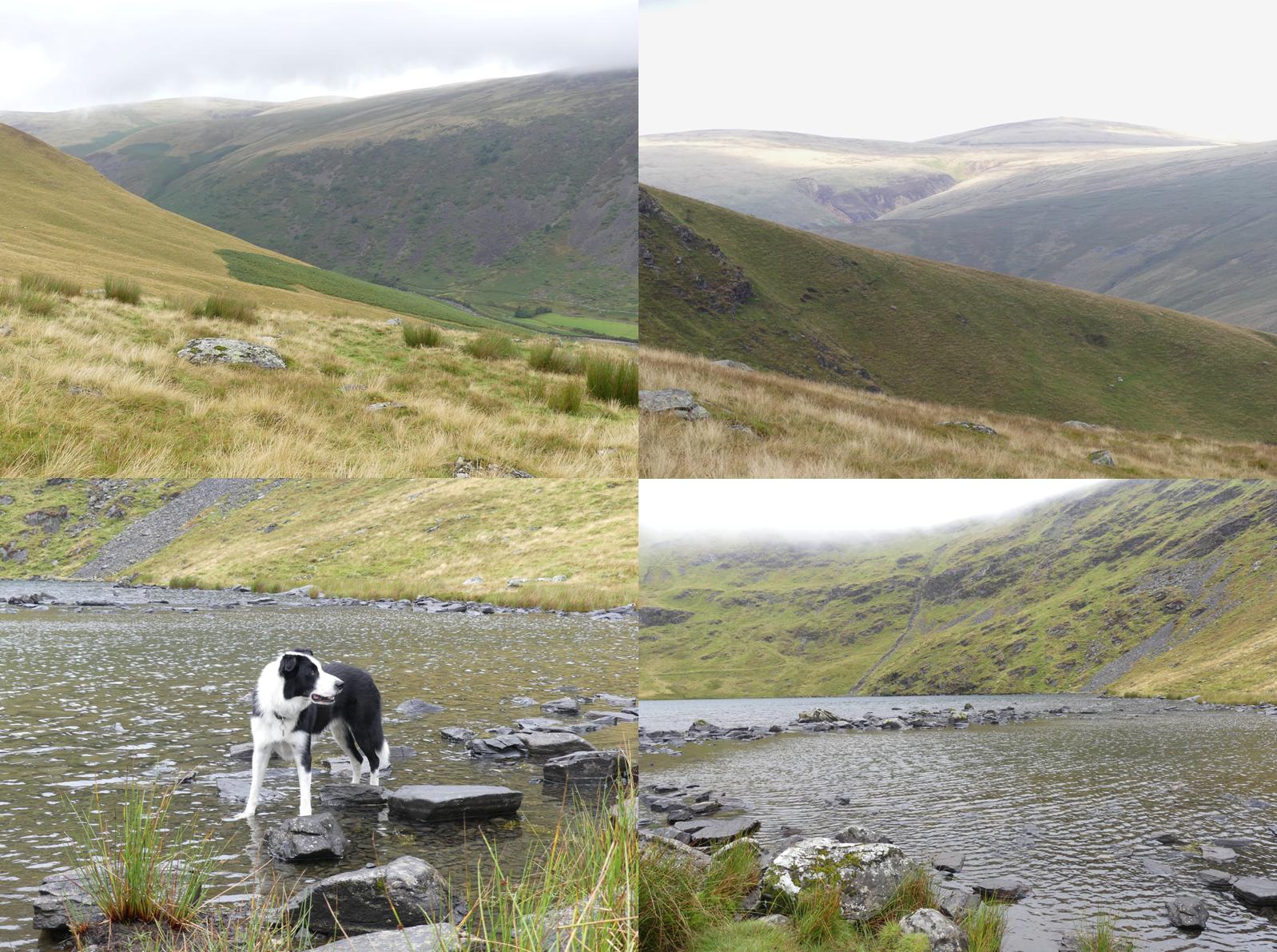 |
| Top left - looking up Swineside and top right - High Pike. Bottom - Bowscale tarn. |
 |
| Tarn Sike which runs from Bowscale tarn is still dry. |
 |
| The summit pile of stones. |
 |
| Mistiness coming up from the tarn. |
Subscribe to:
Posts (Atom)